
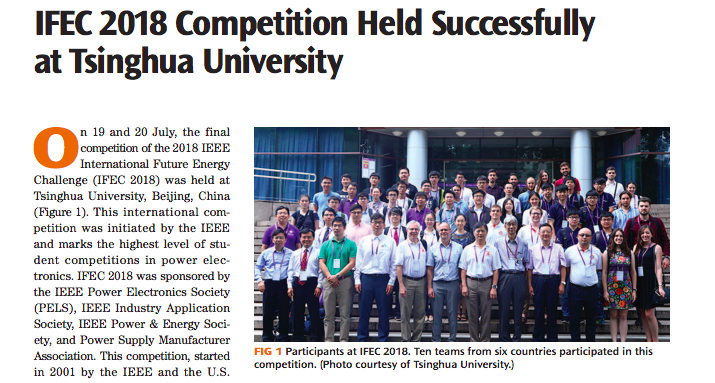
On 19 and 20 July, the final competition of the 2018 IEEE International Future Energy Challenge (IFEC 2018) was held at Tsinghua University, Beijing, China (Figure 1). This international competition was initiated by the IEEE and marks the highest level of student competitions in power electronics. IFEC 2018 was sponsored by the IEEE Power Electronics Society (PELS), IEEE Industry Application Society, IEEE Power & Energy Society, and Power Supply Manufacturer Association. This competition, started in 2001 by the IEEE and the U.S. Department of Energy, invites undergraduate and graduate students from around the world to work together on challenging power electronic topics. It aims to inspire creative thinking and cultivate elite future professionals in the field of power electronics. Participating teams are required to propose an innovative solution to a specific technical problem and build a prototype to verify their design. A grand prize and special awards are given based on the reviews from academic and industrial experts for the proposals and experimental tests for the prototypes.
IFEC 2018 was hosted by the Department of Electrical Engineering, Tsinghua University, with the topic of high-efficiency and high-density isolated bidirectional dc–dc converter for residential energy storage systems.
This event received support from the PELS Beijing Chapter, the China Electrotechnical society, the Tsinghua University Energy Internet Research Institute, and the State Key Laboratory of Control and Simulation of Power System and Generation Equipment. Industry sponsors for the competition included Diamond partner Chroma (Shenzhen) Corporation and Golden partner Mitsubishi Electric Corporation.
The test platform for the final competition was provided by Chroma (Shenzhen) Corporation. Prof. Zhengming Zhao from Tsinghua University served as the general chair of the competition. Dr. Kai Sun from Tsinghua University and Dr. Qiang Li from Virginia Tech, Blacksburg, served as the general cochairs. Prof. Yaow-Ming Chen from National Taiwan University, Taipei City, served as the steering committee chair. The judging panel for the final competition consisted of Prof. Philip Krein from UIUC (member of the National Academy of Engineering and an IEEE Fellow), Prof. Jih-sheng Lai from Virginia Tech (founding chair of IFEC and an IEEE Fellow), Prof. Braham Ferreira from Delft University of Technology, The Netherlands (past president of PELS and IEEE Fellow), Prof. Toshihisa Shimizu from Tokyo Metropolitan University (IEEE Fellow), Dr. Alpha Zhang from the Delta Group, and Dr. Dachong Gu from Unique Technical Services, LLC. Ten student teams from six countries and regions participated in the final competition.
After the exciting two-day competition in oral presentation and hardware testing, student teams from Xi’an Jiaotong University, Tsinghua University, and Beijing Jiaotong University won the Grand Prize Award, Outstanding Performance Award, and Innovation Award with US$10,000, US$5,000, and US$3,000 rewards, respectively. The University of Belgrade, National Taiwan University of Science and Technology, and The Ohio State University received the Educat ion a l Impact Award, Outstanding Technical Report Award, and Outstanding Presentation Award, respectively